Businesses often begin software projects by asking, “What should we build?” A better first question is, “Do we need to build anything at all?”
Depending on your requirements, the right approach may be to purchase an existing platform, develop a custom solution, or modernize software already used by the business. Each option has benefits, costs, and long-term implications.
When buying software makes sense
An established SaaS product is often the fastest option when your requirements are common and do not differentiate your business.
Accounting, communication, payroll, and basic customer relationship management are good examples. Existing products may already provide the required functionality, security, integrations, and support.
Buying is usually appropriate when:
- Your requirements follow a standard business process.
- Speed is more important than extensive customization.
- The subscription cost is reasonable as your team grows.
- The platform integrates with your existing systems.
- You are comfortable depending on an external vendor.
However, licensing costs are only part of the decision. Consider implementation, training, customization, data migration, integration, and the difficulty of moving away from the platform later.
When custom software is justified
Custom development makes sense when your processes, customer experience, or operational model cannot be supported effectively by an existing product.
It can provide greater flexibility, deeper integration, control over data, and ownership of the software. It may also remove repetitive work created by forcing a unique business process into a generic platform.
Custom software is worth considering when:
- Your workflow creates a competitive advantage.
- Several disconnected systems must work together.
- Manual processes are limiting growth.
- Existing products require too many workarounds.
- You need control over functionality, data, and future development.
The trade-off is responsibility. Custom software requires planning, testing, maintenance, security, and ongoing technical ownership.
When modernization is the better answer
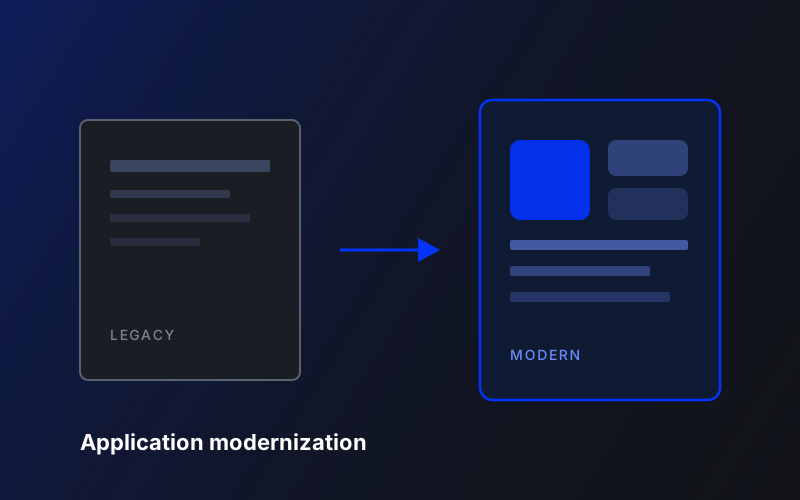
A complete replacement is not always necessary. An existing application may still contain valuable workflows, data, and business knowledge even if parts of it have become difficult to maintain.
Modernization can include:
- Replacing an outdated user interface.
- Improving performance and reliability.
- Introducing APIs and system integrations.
- Moving selected workloads to modern infrastructure.
- Refactoring high-risk parts of the application.
- Improving testing, deployment, and monitoring.
A staged modernization approach can reduce risk because the business continues operating while the application improves incrementally.
A practical decision framework
Evaluate each option against five questions:
- Business fit: Does an existing product support the process without major compromises?
- Time to value: How quickly must the solution become operational?
- Long-term cost: What will development, licensing, support, and change cost over several years?
- Control: How important are software ownership, data access, and customization?
- Risk: What happens if the vendor, platform, or internal system can no longer meet your needs?
The correct answer may also be a combination. A company might purchase a standard platform, build custom integrations around it, and modernize an internal application in stages.
Start with the problem
Technology decisions should begin with business constraints, not a preferred tool. Define the process, users, expected outcome, current limitations, and acceptable level of investment before selecting an approach.
Epnexa helps businesses assess existing systems and choose a practical path across custom development, integration, and application modernization.
Not sure whether to build, buy, or modernize? Start a focused conversation with Epnexa.